




Within the confines of the Dachau concentration camp during World War II, a Jewish prisoner left behind a startling message. He penned a note and concealed it within a violin he painstakingly crafted amid horrific conditions, creating a powerful symbol of hope and resistance that lay undiscovered for over eighty years.
The note, written on tattered paper, read: “Experimental instrument, made under difficult conditions without tools and materials. Dachau. Year 1941, Franciszek Kempa,” as reported by the Associated Press. Franciszek “Franz” Kempa, a skilled instrument maker, was interned at Dachau in southern Germany. Despite the brutal circumstances, he fashioned this violin from whatever materials were available.
For decades, the instrument’s origins remained a mystery until art dealers in Hungary found the violin stored among furniture they had acquired and sent it for repair. This led to the shocking revelation of its past.
The Violin from Dachau – The Story of Franciszek Kempa and the Message Discovered After 84 Years
The Violin
Experts were taken aback by the craftsmanship of the violin. Although the technique was exceptional, the wood and tools were of poor quality. “The proportions and structure reveal the work of a seasoned craftsman,” remarked Szandra Katona, one of the dealers who discovered the violin’s history. “Yet, the choice of materials is truly puzzling.”
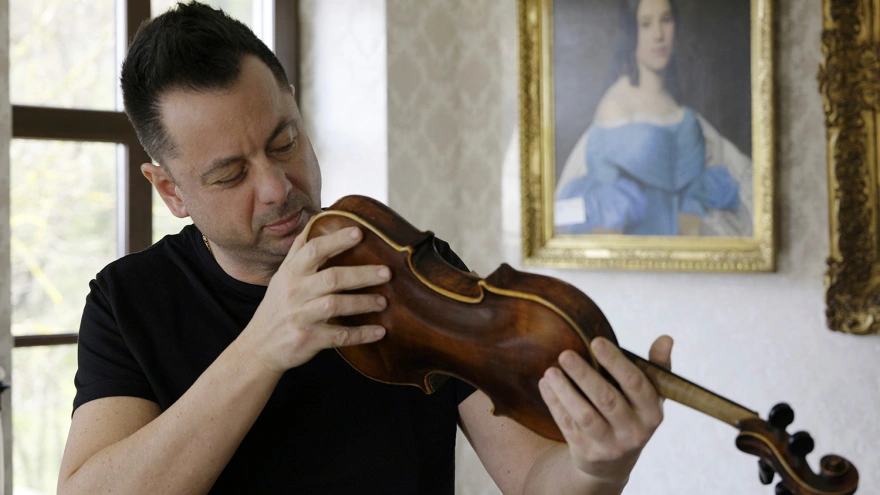
This contradiction led the professional restorer to disassemble the violin, uncovering Kempa’s hidden note—a poignant apology reflecting the grim realities he faced. It stands as a silent testament from within the depths of captivity.
Dachau, established as the first Nazi concentration camp in 1933 near Munich, was initially designed for political prisoners but rapidly evolved into a facility housing Jews, Roma, clergy, homosexuals, and other targeted groups. The camp became notorious for forced labor, medical experiments, and widespread deaths, with at least 40,000 lives lost before its liberation by American forces in 1945.
While the presence of musical instruments in concentration camps was documented—often used in musical ensembles for propaganda—the violin created by Kempa is unique: it is the only known instrument entirely made within a camp.
How the violin transitioned from Dachau to Hungary remains a mystery. However, records from the Dachau memorial museum indicate that Kempa survived the war and returned to Poland, where he continued crafting musical instruments until his death in 1953.
The same records highlight that the Nazis recognized Kempa’s expertise as an instrument maker, a fact that likely preserved his life. Hungarian art dealer Tamas Talosi remarked, “We’ve named it the ‘violin of hope.’”
“When undertaking a project or facing a challenge, one can overcome even the harshest circumstances. This endeavor provided Kempa with a form of release and perhaps even saved his life.”
Ask Me Anything
Explore Related Questions


